"This is not comfortable, easy art. It doesn’t offer clear cathartic solutions. Instead, it asks you to sit with uncertainty, un-resolve, pain, memory, and hope. It requests introspection and space for the internal, the spiritual, and the ancestral. "
Rashid Johnson: A Poem for Deep Thinkers
The Guggenheim New York through January 18, 2026
The Guggenheim New York through January 18, 2026
Rashid Johnson may be the freest artist alive — one who refuses to be defined or confined by medium, message, or easily didactic experiences. Over nearly three decades, his practice has embraced a dizzying array of materials and media — painting, sculpture, video, photography, installation — all employed to probe memory, identity, history, vulnerability, and healing.
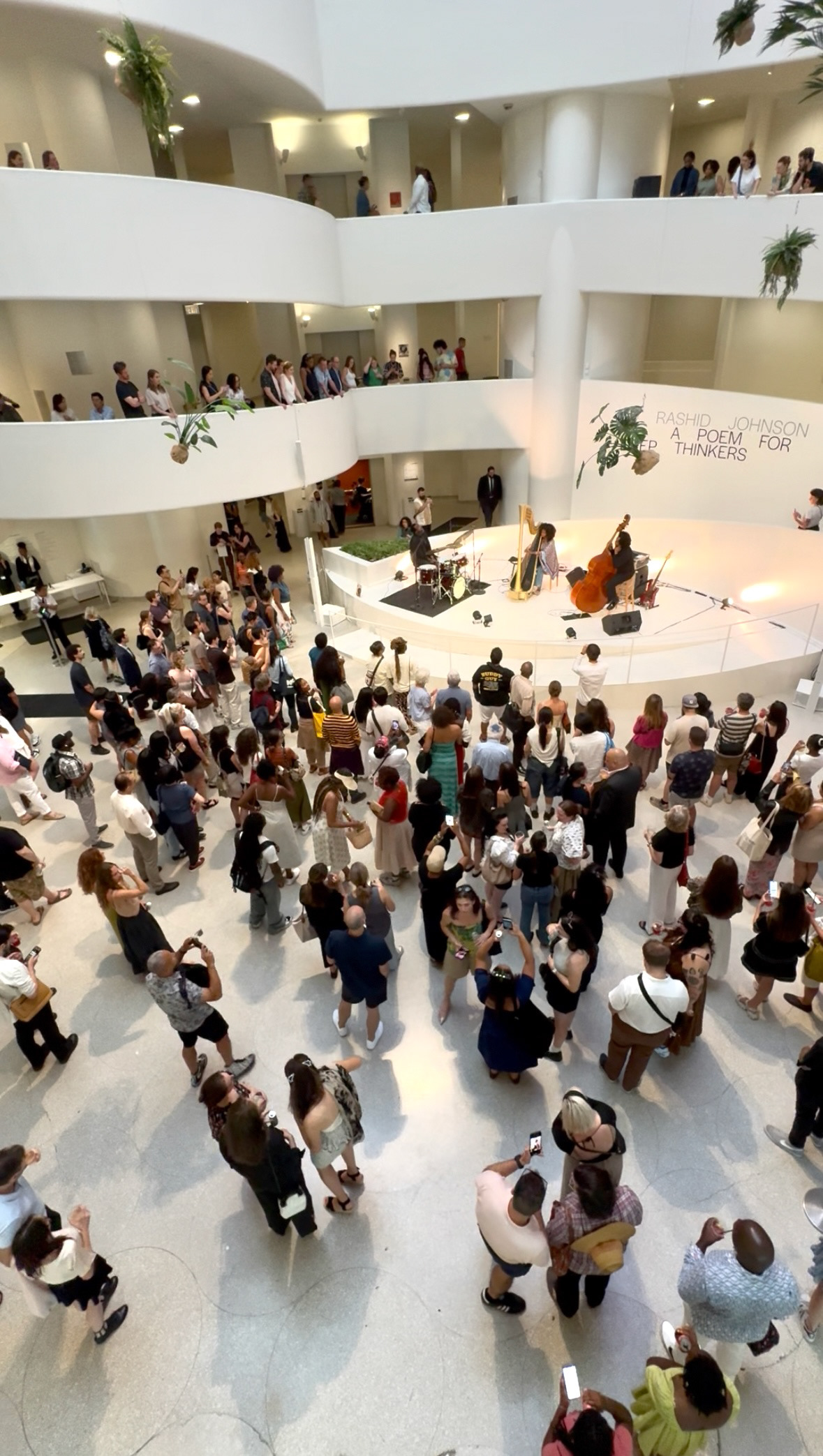
The current exhibition, Rashid Johnson: A Poem for Deep Thinkers, at the Guggenheim in New York, is his first solo show at the institution, and his largest-to-date survey. Spanning more than 90 works drawn from his thirty-year career, the retrospective fills the museum’s legendary rotunda from floor to skylight.
Set within the spiraling architecture designed by Frank Lloyd Wright — a structure whose geometry evokes organic progress, evolution, and movement — the museum becomes more than a container. The building itself seems to echo Johnson’s refusal of linear time.
As you ascend the ramp, the exhibition unfolds not as a traditional chronology, but as an emotional, psychological, and sensory meditation: early works juxtaposed with recent pieces; intimate portraits alongside towering installations; images of anxious crowds beside soft sculptures and fragrant ritual-objects. The journey feels like walking through memories of hope, identity, and resistance.
The show is undeniably textured and — in many moments — sublimely beautiful. Yet Johnson resists tying the conceptual threads together for the visitor. There are no neat moral conclusions. Instead, the exhibition title invites visitors to treat the experience “as a poem for deep thinkers”: to pause, reflect, and feel, rather than consume.
Importantly, Johnson does not limit himself to the visual. Some of the most potent works occupy multiple senses. Materials long associated with Black personal care — shea butter, black soap, wax, ceramic tiles, mirrors, books — appear throughout, transforming familiar objects into carriers of memory and identity.
One standout — described in coverage as “a room-sized installation”1 — is Sanguine, a transformational piece involving steel structure, suspended plants, video screens, and perhaps most evocatively, smell and presence. In that immersive environment, the exhibition’s ambitions become explicit: this is more than art you look at. It is art you inhabit and that transports.
Elsewhere, in works like those from the series Anxious Men and Broken Men — both present in the show — Johnson wrestles with themes of Black masculinity, anxiety, vulnerability, identity, and collective trauma. Faces drawn in contorted lines, repeated across large tiled surfaces, evoke suffering, tension, displacement, and the psychic pressure of history. What might have once seemed comic or stylized now reads as deeply human — even raw.
This is not comfortable, easy art. It doesn’t offer clear cathartic solutions. Instead, it asks you to sit with uncertainty, un-resolve, pain, memory, and hope. It requests introspection and space for the internal, the spiritual, and the ancestral.
As much as the show is visually appealing, inviting even, there are moments of disorientation, hesitation, complexity. The conceptual density — the layering of history, culture, personal biography, and resistance — can feel overwhelming. The paths are not straight, the meanings not spelled out. But perhaps that is the point. It solicits freedom. Freedom from the traditional “art” gaze and in its upward evolutionary spiral — like a double helix of DNA — there is more, always more: more texture, more mediums, more possibility; more memory, more pain, more beauty, more questions than answers. Yet Johnson asks each of us if we are willing: Where do you stand? Who do you bring with you? What do you carry forward?
This is a rare, generous, abundant encounter. A retrospective not only of one artist’s career, but of one’s life in progress, and perhaps a meditation on our collective lives, too.
On view through January 18, 2026.
Frank Mitchell is an artist, arts advocate and Art Coterie contributor
¹ Laura Cocciolillo, “Rashid Johnson’s exhibition in New York is a monument to inner complexity,” art-frame, July 11, 2025, https://art-frame.org/index.php/2025/07/11/rashid-jhonson-exhibition-guggenheim-museum-new-york/.