"He suggests the museum as a secular chapel where civic attention can be concentrated and redirected. These moves are political not because they shout, but because they rearrange what institutions value and what counts as worthy of preservation."
Unto Thee
The Smart Museum of Art through February 22, 2026
Richard Gray through December 20, 2025
The Smart Museum of Art through February 22, 2026
Richard Gray through December 20, 2025
Theaster Gates has long occupied a rare position in contemporary art: part sculptor, part archivist, part urban planner, part ritual-maker. Two simultaneous exhibitions this season — the mid-career survey Theaster Gates: Unto Thee at the Smart Museum of Art (the artist’s first solo museum show in his hometown of Chicago) and the more intimate, haunting presentation OH, YOU’VE GOT TO COME BACK TO THE CITY at Richard Gray (GRAY) — together render the range of Gates’s practice with exceptional clarity. Seen together they read as complementary movements in an ongoing project: the public, civic scale of cultural repair and the private, meditative work of objecthood and memory.
Gates’s biography is essential to how the work reads. Born in Chicago in 1973, trained as a ceramicist and urban planner, he turned early to a practice that repurposes found and institutional detritus into objects and infrastructures of civic life. Over the past two decades he has become best known for transforming abandoned South Side properties into cultural nodes through Rebuild Foundation, for his black-brick sanctuaries and listening houses, and for art that traffics in memory-work: salvaged pews, fragments of Johnson Publishing Company archives, roofing tar, stoneware, and vitrines that collect and reframe histories otherwise consigned to storage. That compound identity — artist, custodian, developer — gives his gallery and museum projects their ambivalent charge: they are aesthetic objects and tools for social repair simultaneously.
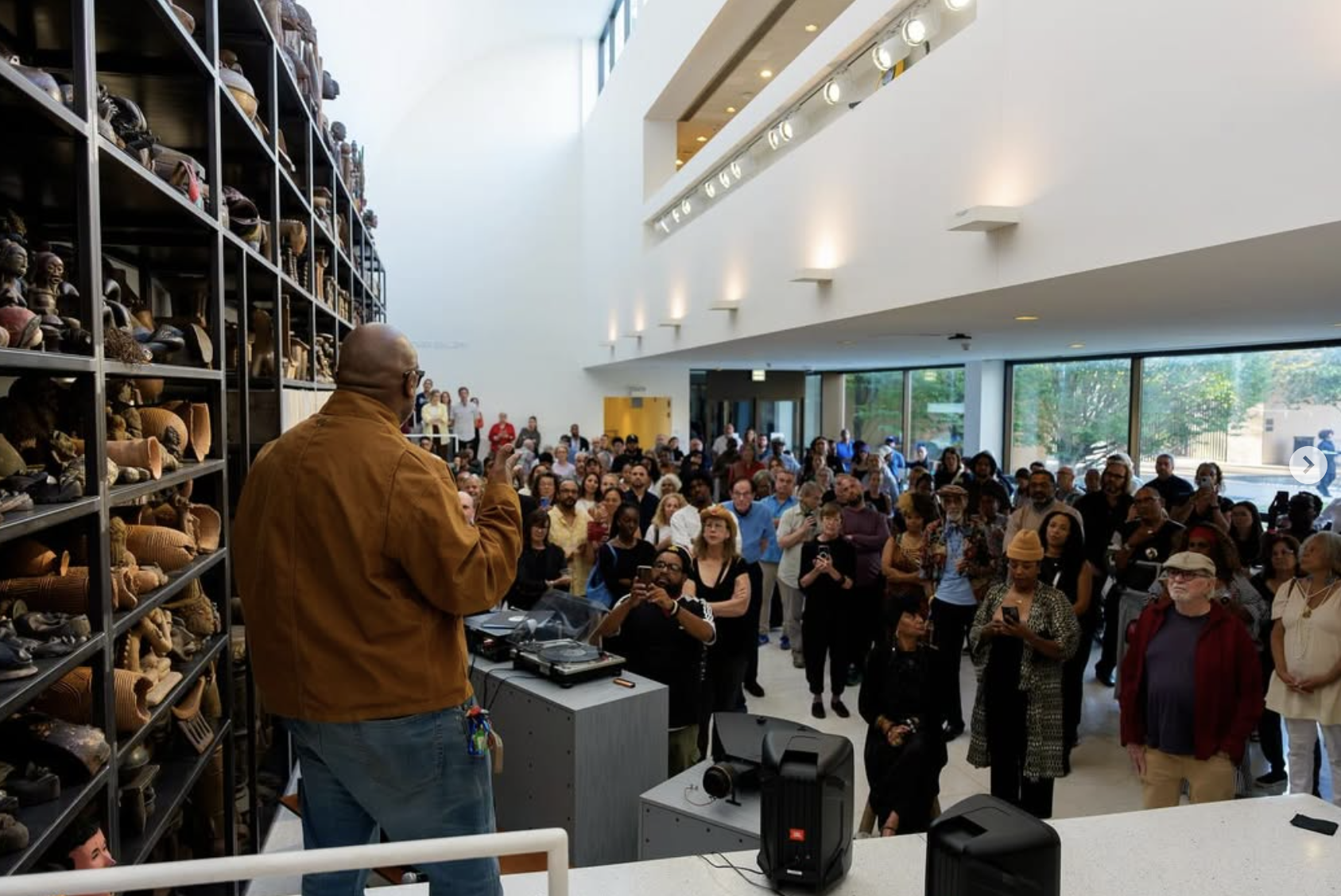
At the Smart Museum, Unto Thee feels like a homecoming that doubles as a reparation ritual. The exhibition draws explicitly on Gates’s relationships with the University of Chicago (where he teaches) and several university collections, bringing glass lantern slides, display vitrines, pews from Bond Chapel, and granite from campus renovations into a single, dense field. Gates arranges these materials with the gravity of an archivist and the choreography of a preacher: rows of vitrines sit like reliquaries on raised platforms; a projection of scanned lantern slides unfolds like a sermon in a darkened side gallery, where the pews themselves become part of the audience. The material logic is crucial — paint-stained concrete, roofing felt, and other working-class materials recur as tactile signatures of labor, landscape, and lineage. In this space Gates insists that seeing is itself a social act; the museum becomes both repository and workshop for collective memory.
Formally, Unto Thee is disciplined in its restraint. Gates does less of the spectacle that sometimes attends his public interventions and instead lets objects accrue meaning through juxtaposition and placement. A striking example is his use of Johnson Publishing Company furniture and ephemera: set beside tar-painted canvases and wood-fired vessels, these corporate artifacts are desacralized and then re-sanctified — refitted into a lineage of Black cultural production that the marketplace had once broken apart. The result is often elegiac rather than polemical; the emotional tenor moves between grief and stewardship. Critics have pointed out Gates’s tendency to build “little bits of holiness” out of ordinary materials, and here that impulse is on full display.
By contrast, the GRAY exhibition OH, YOU’VE GOT TO COME BACK TO THE CITY stages Gates’s relationship to the urban and the personal more lyrically. The gallery show’s title — a line of exhortation and entreaty — reframes Gates’s recurring theme of return: to neighborhoods, to ancestors, and to labor. The works on view at GRAY (ceramics, monolithic pedestals, and an arrangement of vessels) emphasize material presence and bodily scale; the gallery’s quieter, linear layout allows the objects to function like markers in an interior pilgrimage. Where the Smart Museum survey maps networks and archives, GRAY homes in on the formal and symbolic weight of Gates’s objects themselves, urging a slower, closer looking.
Across both shows the symbolic vocabulary is persistent: vessels and containers, archival cases, pews and benches, tar and roofing material, and ceramics fired with visible blemish. Vessels, in particular, recur as metaphors for capacity — to hold history, to carry sorrow, to receive responsibility. The use of industrial stone, salvaged marble, and patinated wood speaks to a theology of reuse: objects accrue sanctity through use and care, not through pristine provenance. Gates’s black bricks (ubiquitous in his earlier public work) are less present here as literal building blocks but remain an implied structural ethic: rebuild, repurpose, anchor. The artist’s rituals — firing pots, mounting archives, setting pews — model a pedagogy of repair that is both material and spiritual.
It’s also worth noting the political subtlety of Gates’s gestures. He rarely issues manifesto-style declarations in text; instead his politics are embedded in the economies of materials and the choreographies of display. By reclaiming corporate furniture from Johnson Publishing, for example, he recoups both cultural capital and narrative authority; by installing pews as viewing benches, he suggests the museum as a secular chapel where civic attention can be concentrated and redirected. These moves are political not because they shout, but because they rearrange what institutions value and what counts as worthy of preservation.
If there is a critical reservation to make, it is one that has followed Gates for years: the scale of ambition sometimes flattens nuance. In an exhibition as broad as Unto Thee, certain juxtapositions feel inevitably curated toward affirmation — a celebratory catalog of stewardship more than a sustained interrogation of the systems that produced the material dispossession in the first place. Similarly, at GRAY, the intimate focus on objects sometimes leans into objet d’art allure in a way that can depoliticize the very histories those objects summon. These are not failures so much as tensions: Gates’s practice always negotiates between aesthetics and activism, and those two logics will occasionally pull in different directions.
Ultimately, both shows reinforce a central promise of Gates’s work: that art can be a durable form of care. Whether assembling vitrines and lantern slides in a museum survey or arranging fired vessels in a white-cube procession, Gates asks viewers to take responsibility for what they inherit — aesthetically, morally, and civically. For Chicagoans, Unto Thee is a landmark, not simply because it is his first major hometown museum show, but because it articulates a twenty-year conversation between an artist and his city. For gallerygoers, OH, YOU’VE GOT TO COME BACK TO THE CITY offers a quieter, concentrated lesson in how objects can hold and teach history. Together, they are less a retrospective than a set of tools for ongoing work: to notice, to rescue, and to repair.
Both exhibitions remain vital not only as art objects but as civic propositions: they model what it looks like to tend to the past without being trapped by it, to make a museum a place of stewardship rather than sequestration, and to insist that beauty itself can be a form of recovery.
Through February 22, 2026
Marta Smusz is an arts advocate in NYC and Art Coterie contributor